Wednesday, February 19, 2014

A Different Kind of Style Book

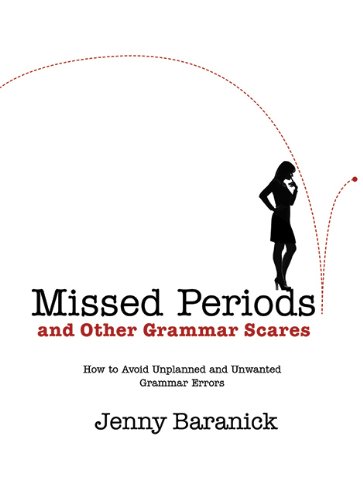
It's called Missed Periods and Other Grammar Scares, by Jenny Baranick,  and it's HILARIOUS.


Keep in mind, I'm a complete nerd, so when I say a grammar book is hilarious, it's because I actually enjoy reading those things. I think Eats, Shoots, and Leaves is fun reading.

If you're one of my readers who isn't a grammar book nerd, you may stop reading now and I won't hold it against you.

For those of you still reading, - here's what I love.

First of all, just the subtitle: How to Avoid Unplanned and Unwanted Writing Errors.

Second, the brilliant lesson in writing a compelling opening. Here's how she launches her first chapter - on the importance of spelling:

Spelling can be as elusive as the female orgasm. We spell a word, and we think, "Ooooh, I think that's it. Wait.... no. Let me just. Oh there, maybe that's it. No. Oh, I don't know...I'm exhausted."

Admit it. You laughed. How could you not? You're hooked, right?

In this same chapter, Ms. Baranick, a college professor, goes on to illustrate the bugaboo SpellCheck. I love how she points out that it merely checks the accuracy of the word you THINK you want to use, blithely allowing you to make an ass of yourself with the WRONG WORD. Think affect instead of effect, and other grand mistakes we make. All. The. Time.

Each chapter is full of All The Mistakes that somehow crept into written English over the years. Like the words "irregardless" and "anyways" - when did that happen? They've never been words. NEVER. I love that she addresses this.

In the chapter on Grammar Myth Busting, Baranick takes aim at the old chestnut we all grew up with: that you cannot end a sentence with a preposition.

You can. Really, I promise. I've been trying to demystify that rule in my business writing classes for years and have had students very earnestly tell me that I am wrong, the rule is right, and they know because their English teacher taught them this when they were in 7th grade.

Sigh. So did mine. She was wrong too. Bless their hearts.

The preposition thing comes from LATIN, people. We speak ENGLISH. The rules aren't the same. PLEASE END YOUR SENTENCES IN PREPS WHEN YOU NEED TO.

Anyone heard the old Winston Churchill joke?  The one where he was poking fun at one of his speechwriters who was dutifully and nonsensically burying prepositions. He said, "This is the kind of pedantic nonsense up with which I will not put".

Nuff said.


Finally, the book is a great teaching aide for anyone (like me) who needs fresh new exercises to help keep students interested.

Anyone else seen it already? What was your favorite part?

What other grammar/style aides do you turn to for help?

Wednesday, February 12, 2014

The Phone Test

I've spent the last 3 weeks or so in critique land. Very little writing, just getting and giving feedback on queries and first 250s.

I've noticed a main theme develop in my comments: Fix the worst writing glitches by following this rule:

Read It Out Loud!

Flow problems? Authentic dialogue? Overwritten?


 When you HEAR your own words, the problems fix themselves. At least 90% of the time. Sometimes they don't, but that's another post.

The thing is, when you use your outside voice, not your internal I-love-these-words voice, you process differently - it's just that simple. Your mouth stumbles over awkward phrasing, overly formal or purply prose.  You know what you would say in "real life". That's what you should actually be writing.

Some of you know I teach writing - business writing. My students work for various US agencies and departments. My job exists because SO many government employees overwrite and crowd their documents with long, fussy, circuitous language. And, for the most part, they know better. But the culture of government writing supports, nay, ENCOURAGES that, so that's what they do.

The truth is, high level leadership wants plainer, simpler language - and certainly taxpayers do too. But the disconnect is huge.  If only I had a dollar for every time I've heard this: "We've always written this way; it sounds more official".

Uh, nope.


So anyway (*forcibly removes herself from her soapbox*), when I help people unlearn bad habits, we chant the Golden Rule. You know it now, say it with me:

READ IT OUT LOUD.

Keep it simple, and they will get it. 
Keep it real, and they will connect.

But, oddly enough, I never thought to apply that to my own creative writing until I read this post from the amazing Authoress, whom many of us depend on for wisdom, truth, and great contests.

She is Dauntless and posts about her own learning curve, so I am going to take a page from her blog and do the same.  Here is what I wrote in one of the early versions of my current query letter:

 It’s also a speculative take on the controversial world of stem cell research.

Say what?

Read it out loud, and you find your tongue stumbling across the consonants. You wonder, now just what does she mean?

But I didn't hear the problems because I didn't SPEAK it, and so, I actually sent it out that way.


So, try it. You'll surprise yourself.

One last note: when in doubt, try what I call the "phone test". When you can't figure out how to word something, pretend you're telling it to someone on the phone. Actually speak out loud. 90% of the time, what you say on the "phone"  is drastically different from what you say when you're staring at the screen.

Be Brilliant!

Wednesday, February 5, 2014

Critique Partners


I participated in SC Author's #Becomeanagent contest this week. Excellent contest, excellent host. Once more, big thanks to SC.

And - Wow. Just, wow. The query I told you about a few weeks ago? The one I was cautiously optimistic about? TANKED!

Really just nosedived - NO ONE liked it.  OUCH.

So, it's back to the drawing board, but once again, because of smart thinking from people who can see everything in my query that I'm too close to see, I have renewed hopes that it can be good one day. Not just I-think-it's-good, but actually, truly good.

And all this has led to today's musings on the importance of a good CP.

We all know what a key piece the puzzle a good critique partner is -- but you know, I'll just say it: It's scary to open your work to someone you've never - and may never - meet in person. Or at least, it is for me.

If you're like me, you send your work to a CP and then you don't really sleep until the critique comes back. You WANT to know what doesn't work, you WANT to know where you're falling short. But it's still nerve wracking. It just is. After all, this is your baby, right? One of them, at least.

Brenda Drake, who many of us know because of her blog and the great contests she generously runs (#Pitmad, anyone?) agreed to share her thoughts on finding and working with critique partners. 

Heather: What are some good questions to ask when considering working with a new CP?

It can be so scary, but it is well worth it. Critiques make our work better and help find holes and things that just aren't working in our manuscripts. 
I think the best questions to ask when deciding if a writer might be your critique partner match would be: What do you write? What do you like to read? How much time do you have for critiquing? How do you like to critique? Do you do line edits or just general notes? How much time do you normally need to do a critique?

Heather: What would be good reasons not to work with someone - meaning, even if someone is accomplished and a good writer, should you pay attention to the differences between you (like personality)? 
I like diversity, so if someone writes something different from me, or their personality isn't like mine, I think that's wonderful. The only time I would not want to work with someone is if he or she is negative. You can tell a lot about a person through a Twitter feed. If the feed is always negative, I'd caution starting a CP relationship. 

Heather: How do you find a CP? 
I haven't looked for a CP in such a long time. I have a small group of friends who are my critique partners. I found them doing NaNoWriMo and participating in contests. I think if you put yourself out there and participate on the hashtags for writer events, you get to know fellow writers. Then all you have to do is ask them. If they tweet about their current work in process and you like the premise, tweet them and tell them you'd love to critique it. It's reaching out that gets you a critique partner. Also, we have www.CPSeek.com where you can post what you're looking for in a critique partner. Others will read it, and if they feel you're a match, they can contact you.


Heather: How many CPs should you work with? And how many people should you agree to be a CP for? 
Each person works differently and needs a different amount of CPs. Some just need one, others need a dozen. It depends on your time and what you can give back to your CPs. I have just a few, and each one offers a special eye to certain elements in a story.

Heather: Sadly, sometimes these professional relationships just don't work out for one reason or another. How do you "break up" without burning bridges? 
I'm a pretty easy going person. I've never had to "break up" with a CP. I think honesty is always best. Just tell them you don't feel like you're connecting enough to their work to give them the critique they deserve. Reading, as we all know, is subjective. Just be kind and direct the problem to yourself than them. Some people can get hurt easily; it's always best to go with the "it's not you, it's me" approach.

Heather: How much work/time should you reasonably expect to ask of a CP? How much work/time should you be expected to make available to CP other people? 
It depends on how much time you have after your day job and family time. I suggest starting out with one to three critique partners and see how it goes. Always be upfront with your critique partners on how much time you have. We all have deadlines, vacations, or just things that happen beyond our control. Keep them informed. I say that you should give your critique partner a few weeks to give you the best critique possible. And you should tell them what to expect from you. If you think you can have it back in two weeks, tell them. Or if something is happening in your life and you need more time, then let them know it might take you longer this time. It's all about communication.


Brenda Drake, the youngest of three children, grew up an Air Force brat and the continual new kid at school. Brenda’s fondest memories growing up is of her eccentric, Irish grandmother’s animated tales, which gave her a strong love for storytelling. So it was only fitting that she would choose to write young adult and middle grade novels with a bend toward the fantastical. When Brenda’s not writing or doing the social media thing, she’s haunting libraries, bookstores, and coffee shops or reading someplace quiet and not at all exotic (much to her disappointment). Brenda is represented by Peter Knapp with Park Literary. Look for her young adult novel, LIBRARY JUMPERS, coming soon.

She runs contests and twitter pitches, and you can find out more on her website: www.brenda-drake.com

And while we're on the subject of critique, here are a few more opportunities for critique workshops:

1) This Friday (2-7), SC Author will post revisions to queries/first 250 for those of you who participated in #Becomeanagent. Anyone can looksee, and all the help is good.

2) Also on Friday, Michelle Hauck will be doing a Critique Workshop on her blog. She's posting the submissions from her two alternates for #TeamSnow. If you entered #sunvvssnow and if you take time to leave feedback on the alternate's submissions, she'll do her best to post your entry for workshopping.
 

Be Brilliant, everyone!!

Friday, January 31, 2014

More Query Critique

Just found another chance for a query critique I wanted to tell you all about:

THIS: http://yastands.blogspot.com/2014/01/letting-your-babies-go-plus-giveaway.htm

This one's a raffle, and you can earn up to 4 chances to win the critique.

Your critiquer: Joshua David Bellin:


Josh is a member of the Pub Hub team (formerly YA Stands for those of you who already follow that blog). He debut novel, the YA sci-fi Survival Colony Nine, comes out in fall 2014. He's repped by Liza Fleissig of Liza Royce Agency.

So, enter!! As Yoda says, (in Bellin's hands, above) "There is no try. There is only do."

I'm definitely entering my YA ms query - would love more eyes and more thoughts about how to make it the query that changes my life. :)

Good Luck!


Wednesday, January 29, 2014

The Query Contest

I've been calling it the #querytrenchblues because the query process feels intimidating and sometimes a little dark. It can be a brain-melting loop of edits to sharpen and shine your ms, especially the first 10, along with endless attempts to encapsulate your brilliant novel in that one-page-come-hither flirtatious wink that is the query letter.

Of course, there comes a time when you have to just swallow hard and submit. Whether you're offering up the 4th or 5th or 20th revision, the act of hitting "send" feels like mustering the courage to fall in love again after your heart's been broken.

And this is why query contests rock -- because there's so much support here to help you find the courage to try again and - bonus! - provide crowd-sourced wisdom to help you make this next effort the one that will work.

A month ago, I never thought I would enter any contests because I felt nervous about sharing my work - even a query - with such a big group of people. I mean, betas, definitely, CP's, yes! But the WHOLE TWITTERVERSE???? Then I dipped my toe into  #Pitmad and discovered something wonderful. The online writing community and the amazing authors who host these contests are SO GREAT!!!!

I come from a gloves-off, casual-cruelty-is-the-norm business, so this kind of earnest, sincere support actually, literally brings tears of relief to my eyes. It's so civilized here in this world!! #Happy.

So for those of you still on the fence about trying one, like I was,  I wanted to tell you, go! go! go! Try one!! To make my point more elegantly, I am thrilled to share with you some comments from the hosts of #sunvssnow, Michelle Hauck and Amy Trueblood.

 Heather: How did Sun vs Snow come about?  

Michelle: 
I couldn't help noticing the contrast between the weather where I live in Indiana and the warmth of my friend Amy Trueblood's area of the country, Arizona. I wanted to do something to liven up the bleh of winter and a query contest taking advantage of the different winter weathers seemed perfect! Agents said yes and the rest is history.  :-)

Amy:

The contest is actually the brain child of Michelle Hauck. She approached me in late October, 2013 and asked if I'd be interested in hosting a contest with her. Michelle and I have known each other for a while and I respected what she did with both Query Kombat and Nightmare on Query Street, so agreeing to host was a "no-brainer" for me!
 
Heather: What are the benefits of participating in Sun vs Snow or any of the other query contests out there?

Michelle:
Querying is a daunting business. I mean even successful querying results in 80 percent rejection. Besides the expected benefit of getting some writers requests from agents, anything to add fun to the grim business is very welcome to my mind. Plus, contests help create a sense of writing community by bringing people together. That's a benefit that can last long after the contest is over. And Sun versus Snow in particular has the advantage of mentors helping writers improve their queries and first pages for the long haul.
Amy:
There are three benefits I think:

1) Getting great feedback from seasoned writers who can help you refine your work.

2) Networking within the writing community. Before Michelle and I even put up the submission details, there was already a group swapping queries and pages and working on their entries together. It's really cool to get to bring people together like that!

3) Getting the opportunity to stand apart from the slush pile which can be very helpful!
 Heather: What was the best  "learning moment"  for you that came out of this contest? 
Michelle:
There are always learning moments. Reading so many queries (212 this time) certainly teaches me what works and what doesn't stand out so much in a query and first page. It also gives me a taste of what agents experience on a daily basis and gives me that much more respect for them. 

Amy:
First, I love this question. Second, I think that all work is subjective. One person may LOVE your work, while another may not be so enthused. The key is to look at the feedback as a whole and decide what makes the most sense for your characters and plot.
 
Heather: Is there a "season" for query contests, or are they held year round?
Michelle:
They've pretty much become year round. I try to space mine out in order to draw new material with each contest.  I co-host Query Kombat in May/June, Nightmare on Query Street in October, and now Sun versus Snow in January/February

Amy:
I'd say most contests are year round. And there are some great ones out there:

PitchWars
Cupid's Blind Speed Dating
Writer's Voice
Pitchmas


Just to name a few.
 Heather: Any quick bits of advice for aspiring writers?  
Michelle:
Don't be afraid to try things out of your comfort zone. Don't hesitate to interact with your fellow writers and form friendships that will help you forever. Never quit.
Amy:
Don't send out your work until you've had it vetted by other writers in your category and genre. Another set of eyes can help you see where your plot is failing or where your voice is inconsistent. Nothing can replace having a great stable of beta readers and critique partners to help you polish your work.

Heather: Last question - do you plan to publish the "Alternates" that didn't make the teams?  
Michelle:
Actually Amy and I have permission from our two alternates to post their queries right after Sun versus Snow ends. Which opens a Critique Workshop opportunity for anyone who entered Sun versus Snow. They can comment with feedback on the alternates' posts and in return I'll post as many of their entries as I can manage. The success of the Critique Workshop will really depend on writers leaving feedback for each other. I'm sure I can depend on that. I've found that writers love to help other writers! 

Amy:
Yes. At the conclusion of the contest, Michelle and I are going to post our alternates and work with them on feedback.

Thanks so much, Michelle and Amy, for your time and for paying it forward by sharing your expertise with the rest of the community.
If you participated in #SunvsSnow and want to take part in the Critique Workshop, keep following the Twitter hashtag #sunvvssnow.
To get some great advice on what does and doesn't work in a query, I really recommend you read through the queries that have been mentored and are now being critiqued by agents on both Michelle's (#TeamSnow) and Amy's blogs (#TeamSun). And even if you're burned out on queries for now, read the blogs anyway. They each feature helpful agent and author interviews plus other great writerly thoughts.

 Also note that the ubiquitous Michelle is a Bouncer on the Cupid's Blind Speed Dating Contest, which is open for entries until tonight!

Good luck, everyone, and as always, 
Be Brilliant.


Sunday, January 12, 2014

New Query

No surprise here, the exercise of peeling back my ms to 140 characters was GOOD. I mean, so good, that the Tweets I wrote revealed with painful clarity just how terrible my query letter was. I mean, rancid. UGH. Because it reflected NOT ENOUGH of my book's conflict and only hinted at the catalyzing event.

I was being coy. And it was getting me nowhere. I haven't queried that much, but clearly the letters haven't set anyone's world on fire, so what I was doing wasn't working.


Argh. I want it to be perfect NOW. *Sweats*  Impatient much? Yah. Always. Anyway, I took a hatchet to it, rewrote the thing, and now it's shiny & new. I actually feel cautiously optimistic. I've sent it to one agent (crossing fingers) and am also getting ready for #sunvssnow.

Query Shark is a beautiful thing, by the way: http://queryshark.blogspot.com.
She's brutal, but it's all so very, very good. I made a few very important changes based on critiques of other queries from this blog, which is exactly what Janet Reid (the shark) intends. She's not interested in seeing your query for critique unless you've read her entire archive - hoping that many will answer their own questions just by reading how others have made the same mistakes.

Another great post on writing a good query: http://natashaneagle.com/tag/query-formula

I think we all  feel frustrated on occasion about the difficulty of writing a good query.
If AgentQ could see past my terrible query, he/she would discover my amazing ms!!

But of course, that's not true. Not at all. The thing about the query is, it really does reflect your writing talent. Because if you can clearly, concisely capture your plot, conflict, and characters, you're in command of your work. And your words. And if you can sell it, you're a good candidate for the partnership that is agent-author.

One more note, a bit of irony for me. In my years as a reporter, one of the things that used to set my teeth on edge about the process of moving from job to job in the tv news biz was that in spite of the quality of my work, the job offers usually came down to whether the news director like my presence. My personality. My FACE. I worked simultaneously on being smart, talented, connected, and photogenic, and that always felt a little wrong.


Now as I reinvent myself in this new career, I am judged ONLY by the content of my writing and it's very unsettling. Because I keep thinking, If AgentA could see how nice I am, how personable -- maybe he/she might like my ms!!!

Change is good. Sigh. *Laughs self-deprecatingly*
Wish me luck with the new letter!


Tuesday, January 7, 2014

#Pitmad

Another contest!!

I didn't make it into the final round of One on One, but in my asking around about it, I heard about #Pitmad.

I've read agents' blogs who don't like these Twitter pitch contests and I've read those who do -- and, as with everything in life, there are good reasons to Tweet or not to Tweet. (Sorry, couldn't help it).

I've decided to go ahead and try, largely because of the amazing support and critique opportunities that come along with it.

If you're wavering, or if you have pitches you'd like to test on other writers for helpful feedback, THIS:

natashaneagle.com/pitmad-pitch-practice

I've already had some valuable feedback about my pitches from "workshopping" my original efforts.

The other reason I decided to try #pitmad is this: it's good for me.

For those (few) of you who haven't yet, try generating a 140-character pitch for your WiP anyway. The practice forces you to distill for yourself the most basic elements of your story, theme, conflict, and plot - a very healthy, if bracing, exercise. Among the benefits? Perhaps a new approach to your query letter, a new understanding of your own work, and a new perspective that might bring on a fresh round of edits. (I know, no one likes edits - but, to keep with the healthy exercise metaphor, no pain no gain, right??????)

Another extremely helpful link for those struggling to write a pitch:

http://annerallen.blogspot.com/2013/12/the-secret-to-writing-dreaded.html

Good luck, everyone! And be brilliant. :)